Get Started
Your first automation
Schedule recurring agent work and review the output the next time you sit down.
Automations turn "ask the agent again" into "come back with work to review." Schedule a coding agent against a repo, give it a task it should run on a cadence, and let the next morning start with results instead of prompts.
Pick something repeatable
The best first automation is something you already do twice a week and wish you didn't.
Good candidates:
- A morning brief from Slack, GitHub, and Linear.
- Bug triage from Sentry or your support inbox.
- Docs drift- compare recent PRs against the docs and open fixes.
- Dependency or test-suite checks.
- A weekly summary of merged PRs.
Pick one. Don't over-design the first run; you'll iterate after you see the output.
Create the automation
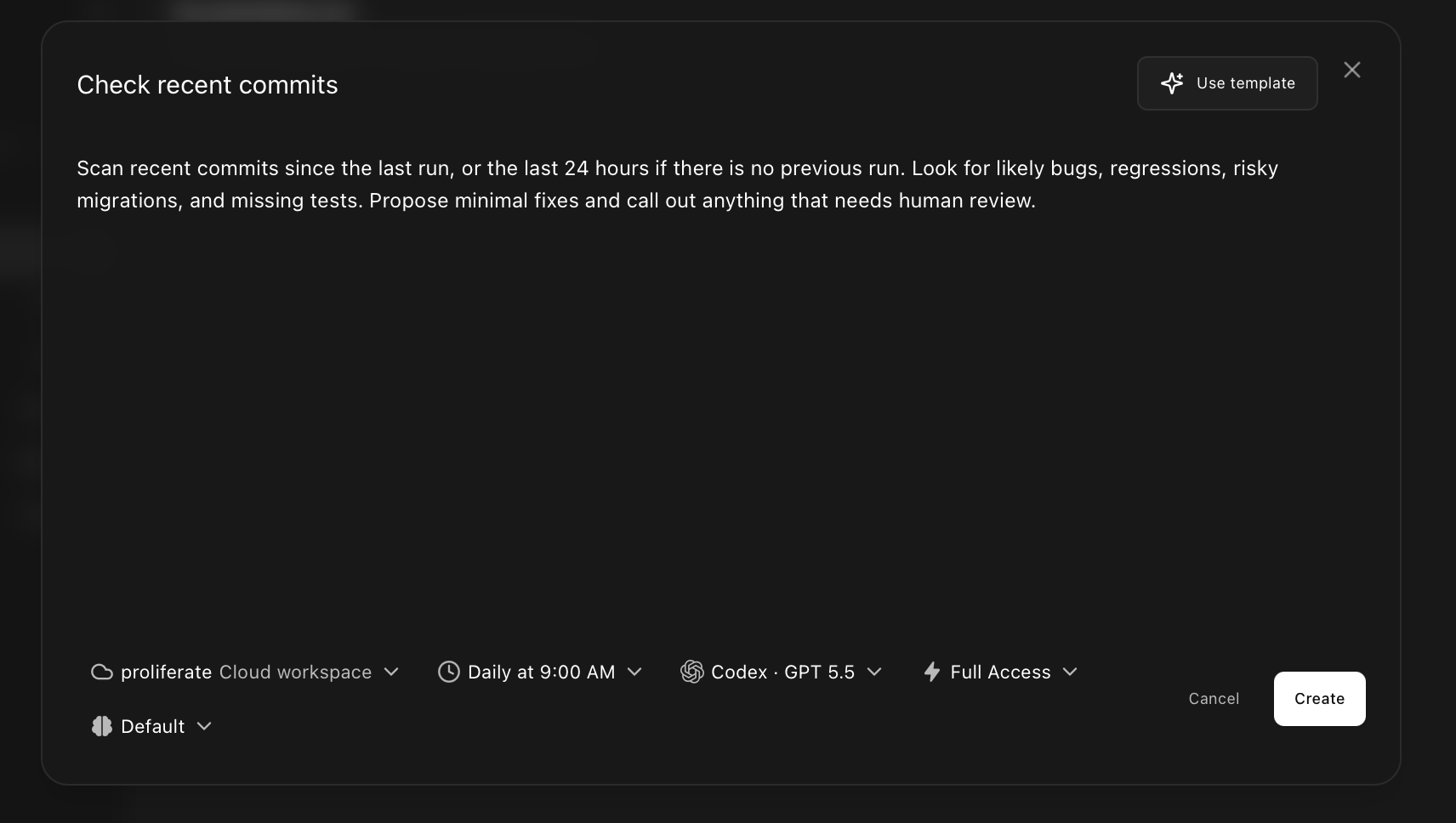
From the Automations sidebar, click New automation and configure:
- Schedule- a cron expression, an interval, or "manual only" while you're testing.
- Target- the workspace, repo, Cowork thread, or cloud environment the run should land in.
- Agent- harness, model, and access level. Most first automations want planning or read-only mode until you trust the output.
- Prompt- the work the agent should do every run. Keep it tight; an automation prompt is rerun verbatim, so vague phrasing compounds.
- Review (optional)- gate the output through a reviewer personality before it lands.
Test before scheduling
Run the automation manually first. The composer has a Run now button right next to the schedule.
Open the run output and check:
- Did it produce the artifact, summary, or diff you expected?
- Did it touch anything it shouldn't have?
- Is the prompt narrow enough that the next run will look the same?
Iterate on the prompt and configuration until a manual run is reliable. Then turn on the schedule.
What happens next
Scheduled automations run on the cadence you set. Each run shows up in the run history with its diff, transcript, and summary- so when you sit down the next morning, you can see exactly what the agent did, accept or revise the work, and move on.
If you haven't yet, run an automation in the cloud so it keeps working while your laptop is closed.